UniCal Urges Practical Action on Climate Change, Pollution and Environmental Protection
By Wakirike Herald
The Vice-Chancellor of the University of Calabar, Prof. Offiong Offiong, has urged stakeholders to turn environmental knowledge into practical measures that protect ecosystems and support human development.
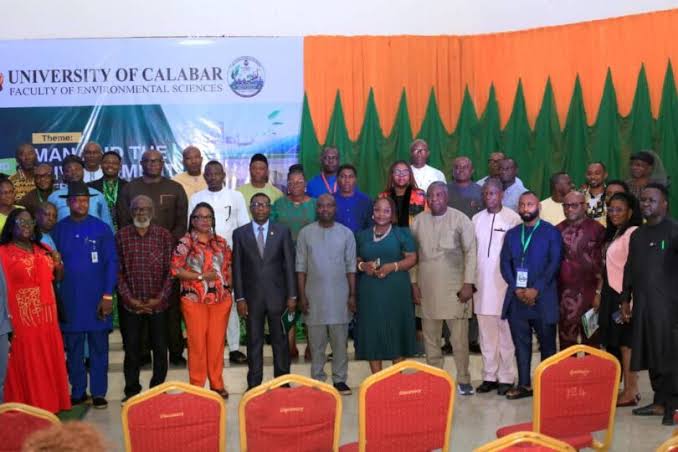
Offiong made the call on Saturday at the second International Conference of the university’s Faculty of Environmental Sciences, themed “Man and the Environment: Interactions, Impacts and Pathways to Sustainability”.
Represented by the Deputy Vice-Chancellor for Research, Linkages and Collaboration, Prof. Egrinya Eneji, he described the environment as fundamental to human survival and development, requiring deliberate efforts to protect and improve it.
He encouraged participants to use the conference to exchange knowledge, build partnerships and develop workable responses to environmental challenges.
Commending the faculty for convening the gathering, Offiong described it as timely and academically significant. He expressed optimism that its deliberations and resolutions could contribute to environmental protection.
Confronting Multiple Environmental Pressures
The Dean of the Faculty, Prof. Francis Okpiliya, said the conference came at a time of growing concern over climate change, pollution, biodiversity loss, rapid urbanisation, resource depletion and environmental health.
He said these challenges required knowledge from different disciplines, innovative thinking, effective governance and collective action.
According to Okpiliya, the gathering provided a platform for academics, industry operators, government representatives, civil society organisations and other stakeholders to present research, examine difficult questions and explore collaboration.
The range of issues identified placed both ecological protection and the effects of human activity at the centre of the discussions.
Connecting Research Across Disciplines
The Chairperson of the Local Organising Committee, Prof. Elizabeth Andrew-Essien, said collaboration across disciplines was essential to understanding environmental problems and developing effective responses.
She explained that the environment included both natural and human-made systems, making it necessary to examine how human activities interact with the ecological systems that sustain life.
The conference sub-themes covered human environment and governance, land-water ecosystems, the built environment, health, energy, pollution, climate and environmental economics, digital innovation and creative arts.
Andrew-Essien urged participants to combine specialised research with broader engagement, noting that the complexity of environmental challenges required experts to learn from one another.
She expressed the hope that the discussions would produce new research findings and practical knowledge useful to Cross River State, Nigeria and the wider world.
From Discussion to Implementation
The conference featured panel discussions, scholarly presentations and interactive sessions intended to strengthen environmental knowledge, policy and practice.
Its attention to land-water ecosystems, pollution and climate also holds relevance for coastal and riverine communities, where environmental protection is closely connected to livelihoods and community wellbeing.
While speakers outlined the gathering’s ambitions, the supplied account did not identify specific resolutions, implementation timelines or funding arrangements.
The next measure of its impact will be how the knowledge and partnerships developed at the conference translate into practical action for the environment and the people who depend on it.
Wakirike Herald
The Voice of Wakirike People Everywhere
Written by
wk-admin
Comments
- Be the first to comment.