WHO Member States Set May 2027 Deadline to Finalise Global Pandemic Agreement Annex
By Wakirike Herald
Member States of the World Health Organisation (WHO) have reaffirmed their commitment to finalising the Pathogen Access and Benefit-Sharing (PABS) Annex to the WHO Pandemic Agreement by May 2027.
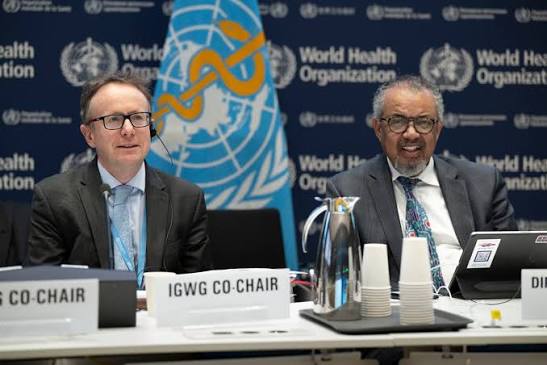
The commitment followed two weeks of negotiations by the Intergovernmental Working Group (IGWG), which recorded progress on provisions designed to promote equitable access to medical products during future pandemics.
According to a WHO statement issued on Friday, November 13, 2026, the proposed annex seeks to establish a system for the rapid and transparent sharing of pathogens with pandemic potential and their genetic sequence data, alongside fair access to vaccines, diagnostic tools and therapeutics developed from such resources.
The framework is intended to strengthen international cooperation while ensuring that countries contributing biological materials and scientific information can also benefit from the medical products developed through their use.
Negotiations focus on equitable access and benefit-sharing
Brazilian Ambassador Tovar da Silva Nunes, Co-chair of the IGWG Bureau, said negotiators had made important progress on benefit-sharing and access provisions during the discussions.
He explained that member states remained focused on establishing a practical and equitable system capable of delivering public health benefits when future pandemic threats emerge.
According to Nunes, discussions also advanced understanding of the responsibilities of participating partners and how the proposed arrangement could facilitate access to pandemic-related health products.
Negotiators also considered access to pathogens with pandemic potential, including biological materials and genetic sequence information, as well as the responsibilities of laboratories and technical partners.
France's Ambassador and Co-chair of the bureau, Anne-Claire Amprou, described the negotiations as constructive, noting that formal and informal discussions had helped countries identify areas of common ground.
She said member states remained committed to refining the proposed annex and completing negotiations in time for consideration by the World Health Assembly in May 2027.
WHO chief urges countries to sustain momentum
WHO Director-General, Dr Tedros Ghebreyesus, commended member states for the progress recorded and urged delegations to translate their commitments into decisive action.
Tedros said the outcome of the ninth IGWG meeting provided encouragement, expressing hope that participating countries would maintain the momentum during subsequent negotiation sessions.
WHO experts provided scientific, legal and operational support throughout the discussions to help member states address complex issues and advance the proposed framework.
Further negotiations scheduled for 2027
Member states agreed to continue discussions through informal sessions aimed at narrowing outstanding differences before formal negotiations resume.
The next formal negotiation sessions are scheduled as follows:
-
January 11–15, 2027: Resumption of formal negotiations.
-
February 15–19, 2027: Further negotiations on outstanding provisions.
-
March 15–25, 2027: Additional negotiations ahead of the World Health Assembly.
The May 2027 deadline is expected to provide an opportunity for member states to present the completed annex for consideration by the World Health Assembly.
Why the agreement matters to developing countries
The proposed PABS framework addresses an important challenge in global health cooperation: how to balance the rapid sharing of information about dangerous pathogens with fair access to the medical products developed from that information.
For developing countries, particularly those with limited pharmaceutical manufacturing capacity, the negotiations carry significant implications.
A workable benefit-sharing arrangement could help address inequalities in access to vaccines, diagnostics and treatments during future health emergencies.
The WHO Pandemic Agreement was adopted by member states in May 2025 to strengthen international cooperation in preventing, preparing for and responding to future pandemics.
Following its adoption, countries established the IGWG to advance implementation, including the negotiation of the PABS Annex.
However, the success of the proposed framework will depend on the final terms agreed by member states, the responsibilities assigned to participating institutions and the effectiveness of the arrangements for ensuring equitable access.
As negotiations continue, the central question remains whether countries can translate their shared commitments into a practical system that protects global health while ensuring that the benefits of scientific cooperation are fairly distributed.
Wakirike Herald
The Voice of Wakirike People Everywhere
Written by
wk-admin
Comments
- Be the first to comment.