Tinubu: Education Investment Is Best Tribute to Herbert Macaulay
By Wakirike Herald
President Bola Tinubu has identified sustained investment in education as the most meaningful way to honour the legacy of Herbert Macaulay, one of Nigeria's foremost nationalists and pioneers of the country's independence movement.
The President made the statement on Saturday, November 14, 2026, during a memorial colloquium in Lagos marking the 80th anniversary of Macaulay's death.
Represented by the Deputy Vice-Chancellor of the University of Lagos, Prof. Afolabi Lesi, Tinubu said Macaulay's courage, sacrifice and commitment to public service helped lay the foundation for Nigeria's nationalist movement.
He maintained that the present generation must preserve that legacy by investing in education, developing informed citizens and nurturing visionary leaders.
According to him, education remains essential to building a prosperous nation and preparing young Nigerians to compete effectively in the global economy.
Tinubu highlights education and youth empowerment initiatives
The President said his administration's Renewed Hope Agenda prioritised access to quality education, skills development and innovation.
He identified the Nigerian Education Loan Fund (NELFUND), skills development programmes and start-up grants for young entrepreneurs as some of the Federal Government's interventions aimed at expanding educational and economic opportunities.
Tinubu also stressed that nation-building required visionary leadership, responsible citizenship and a sustained commitment to the common good.
Describing Macaulay as a fearless advocate of justice and self-determination, he urged political leaders and public officeholders to reflect on the legacy they intended to leave behind.
He commended the Macaulay family, Chief Olabode George and the Macaulay Heritage Foundation for their efforts to preserve the nationalist's contributions to Nigerian history.
Sanwo-Olu celebrates Macaulay's leadership legacy
Lagos State Governor Babajide Sanwo-Olu also paid tribute to Macaulay, describing his courage, leadership and dedication to public service as enduring sources of inspiration.
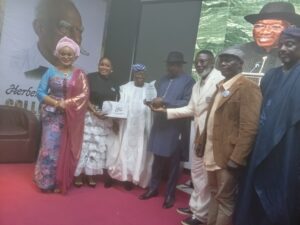
The governor, represented by the Secretary to the Lagos State Government, Mrs Bimbola Hundeyin, spoke while receiving the Herbert Macaulay Award for Leadership in Public Service, Cultural Ambassadorship and Urban Development.
Sanwo-Olu expressed appreciation to Macaulay's descendants and the Macaulay Heritage Foundation for the recognition.
He described Macaulay as an engineer, architect, political leader and nationalist who championed the right of Nigerians to participate in the governance of their country at a time when political participation was severely restricted.
He particularly highlighted Macaulay's establishment of the Nigerian National Democratic Party (NNDP) in 1923 as an important milestone in Nigeria's political development.
According to the governor, Macaulay's advocacy for fairness, public accountability and the welfare of ordinary citizens offers important lessons for contemporary leadership.
"The true measure of leadership is not the office one occupies, but the lives one touches, the institutions one strengthens and the legacy one leaves behind," he said.
Sanwo-Olu added that his administration's development agenda was centred on improving residents' welfare, strengthening public responsibility and investing in Lagos' creative and cultural industries.
Historian warns against ethnic nationalism
Delivering the keynote address, Emeritus Professor of History, Akinjide Osuntokun, called for a more inclusive understanding of nationalism and nation-building in Nigeria.
Speaking on the theme, "Nationalism, Nigeria and Nation-Building," Osuntokun argued that Nigeria should be understood as a multinational state rather than a conventional nation-state because of its diverse ethnic, linguistic and cultural identities.
He said the country's challenge was to develop a shared sense of belonging that would allow its different nationalities to coexist peacefully under one government.
The historian warned that ethnic sentiments, tribalism and extreme nationalism could undermine national unity when they promote superiority, territorial expansion or hostility towards other groups.
Drawing lessons from European history, he cited Germany and Italy as examples of countries where nationalist movements contributed to political unification but also demonstrated the dangers of extreme nationalist ideologies.
He further explained the concept of irredentism, describing it as the desire of a country or ethnic group to reclaim territories or reunite with people considered part of its national community but living outside its borders.
He cautioned that attempts to annex territories based on ethnic or linguistic connections could trigger serious political and security crises.
Osuntokun also observed that the anti-colonial nationalism that united Nigerians against British colonial rule did not automatically guarantee national cohesion after independence.
Scholars call for intellectual courage and stronger federalism
During the discussions, renowned political scientist Prof. Adele Jinadu emphasised the importance of understanding Nigeria's state-formation process.
He described Macaulay as a leader who was prepared to speak truth to power and criticised what he considered a decline in the willingness of contemporary intellectuals to challenge authority.
Jinadu called for greater public engagement by academics and professionals in national debates.
Similarly, the Director-General of the Nigerian Institute of International Affairs (NIIA), Prof. Eghosa Osaghae, discussed federalism as a framework for accommodating Nigeria's diverse national identities and addressing separatist agitations.
He noted, however, that federalism was a continuing process that required adjustments in response to changing political and social realities.
Media freedom identified as part of Macaulay's legacy
The Executive Director of the International Press Centre (IPC), Dr Lanre Arogundade, highlighted education for all, freedom of expression and political movements that genuinely represent citizens as important lessons from Macaulay's nationalism.
He expressed concern about what he described as growing intolerance of criticism in Nigeria, arguing that democratic leadership must accommodate public scrutiny and dissent.
Arogundade maintained that the willingness of nationalists such as Macaulay to challenge authority contributed to the struggle for independence and the democratic freedoms enjoyed today.
Remembering Macaulay beyond the anniversary
The memorial colloquium brought together political leaders, academics, traditional representatives and other dignitaries to reflect on Herbert Macaulay's contribution to Nigeria's political history.
Among those present were former Minister of External Affairs, Gen. Ike Nwachukwu; Mrs Margaret Shonekan; Prince Tajudeen Olusi; former Lagos Deputy Governor, Alhaja Sinatu Ojikutu; and several White Cap Chiefs.
The discussions highlighted an important dimension of Macaulay's legacy: the struggle for political participation, accountable leadership, education and the right of citizens to influence the affairs of their country.
Eighty years after his death, the challenge for Nigeria is to translate those ideals into functioning institutions, inclusive governance and opportunities for future generations.
Honouring Macaulay, therefore, requires more than remembering his name. It demands a sustained commitment to education, democratic freedoms, national inclusion and public service.
Wakirike Herald
The Voice of Wakirike People Everywhere
Written by
wk-admin
Comments
- Be the first to comment.