Nigeria Requires 450 Million Bundles of Cassava Stems Annually to Meet Farmers’ Demand – IITA
By Wakirike Herald
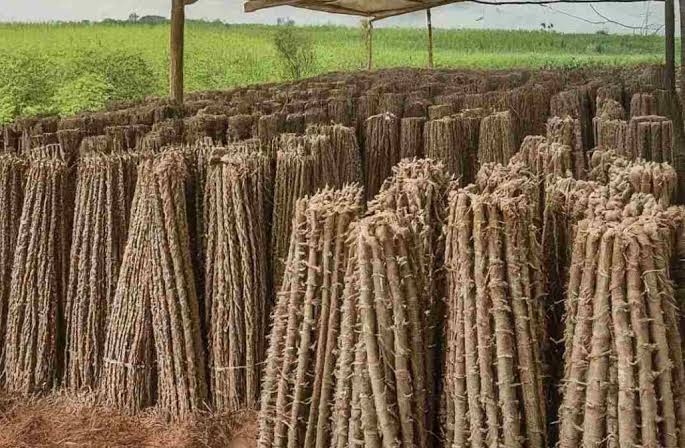
Nigeria requires more than 450 million bundles of cassava stems annually to meet the planting material needs of farmers across the country, according to the International Institute of Tropical Agriculture (IITA).
The disclosure highlights a major challenge facing Nigeria's cassava industry, as inadequate access to quality planting materials continues to limit the productivity and profitability of millions of smallholder farmers.
Mr Kayode Olasupo, an agronomist with IITA GoSeed, made this known in an interview with the News Agency of Nigeria (NAN) in Abuja on Monday, November 23, 2026.
Olasupo described Nigeria as the world's largest cassava producer but said the country currently supplies less than 10 per cent of the estimated annual demand for cassava stems.
High Transportation Costs Discourage Farmers
According to the agronomist, the shortage is partly connected to the limited presence of commercial seed companies within farming communities.
He explained that farmers often spend considerable amounts transporting planting materials from distant locations, with logistics costs sometimes exceeding the actual cost of the materials.
He called for more commercial seed entrepreneurs and other stakeholders to participate in the cassava value chain, particularly by establishing businesses closer to farming communities.
Olasupo noted that estimates from IITA projects indicated that more than six million smallholder farmers cultivate cassava across Nigeria.
He said the demand for planting materials far exceeded available supply, forcing many farmers to depend on neighbouring farmers, recycle old stems or purchase uncertified and unimproved varieties.
Such practices, he warned, could undermine efforts to improve cassava productivity and increase farmers' earnings.
Limited Access to Improved Varieties Affects Productivity
The IITA agronomist explained that several improved cassava varieties developed and released by research institutions had not reached farmers in sufficient quantities.
He said the benefits of agricultural research would remain limited if farmers could not access the improved varieties developed to increase production.
According to him, reliable access to quality planting materials would help farmers improve yields, increase profitability and strengthen their livelihoods.
He stressed that bridging the gap between agricultural research institutions and farmers was essential to improving Nigeria's cassava production system.
IITA GoSeed Deploys Technology to Increase Supply
Olasupo identified IITA GoSeed as an early-generation seed company using modern technologies to multiply improved cassava varieties and make quality planting materials more accessible to farmers.
He explained that the organisation was working to reduce the time required to move newly released varieties from research institutions to farming communities.
One of the technologies being deployed is Semi-Autotrophic Hydroponics (SAH), which allows large quantities of cassava planting materials to be produced from a single stem.
According to him, the technology could enable newly released varieties to reach farmers within two to three years, compared with the much longer periods associated with conventional multiplication methods.
He explained that cassava's traditionally low multiplication ratio had restricted the availability of planting materials, with conventional methods producing approximately 10 stems from one stem.
However, SAH technology could potentially generate hundreds of thousands of plantlets annually from a single stem under suitable production conditions.
Expanding Seed Supply Critical to Nigeria's Cassava Industry
Nigeria's cassava industry supports millions of farming households and supplies raw materials to several sectors, including food processing, animal feed and industrial production.
However, the gap between the demand for quality planting materials and available supply presents a major challenge to efforts aimed at increasing productivity.
Expanding commercial seed production, improving distribution networks and reducing transportation costs could help farmers access improved varieties more easily.
For Nigeria to maximise its position as the world's leading cassava producer, attention must extend beyond the volume of cassava harvested to the quality, availability and affordability of planting materials.
The proposed expansion of improved seed production offers an opportunity to strengthen the agricultural value chain, but its impact will depend on how effectively the technology and planting materials reach smallholder farmers across the country.
Wakirike Herald
The Voice of Wakirike People Everywhere
Written by
wk-admin
Comments
- Be the first to comment.