Fires Hit Two Tankers and Tugboat in Strait of Hormuz Amid Rising Maritime Attacks
By Wakirike Herald
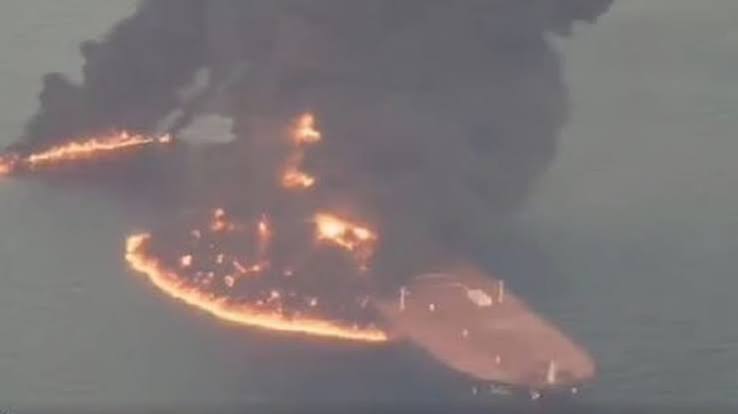
Two oil tankers and a tugboat have caught fire in the Strait of Hormuz, according to Iranian media reports citing the Islamic Revolutionary Guard Corps (IRGC), amid growing security concerns over commercial shipping in the strategic waterway.
The Fars news agency reported early Thursday that one of the tankers had struck a mine, triggering a fire. However, it provided no details about the cause of the fire aboard the second tanker.
The tugboat, which had approached the vessels to assist with firefighting operations, also caught fire, according to the report.
The circumstances surrounding the incidents could not immediately be independently verified.
The Strait of Hormuz is one of the world's most important maritime routes, connecting the Persian Gulf to international shipping lanes and facilitating the transportation of substantial volumes of global oil and gas supplies.
Its security has come under increasing pressure following repeated attacks on commercial vessels in and around the waterway. The United States has blamed Iran for the attacks.
Maritime Attacks Reach Record Weekly High
An analysis by BBC Verify of incident reports from the United Kingdom Maritime Trade Operations (UKMTO) agency indicates a sharp increase in attacks on vessels in the region.
According to the analysis, 12 vessels reported attacks between October 5 and 11, the highest weekly figure recorded by UKMTO since the US-Israeli war with Iran began.
This followed 10 reported attacks during the preceding week.
Six vessels were reportedly attacked on the same Sunday, marking the highest number of incidents recorded in a single day.
BBC Verify explained that its timeline was compiled using the first dates cited in UKMTO incident reports. The figures are therefore approximate because some reports identify the date of an attack, while others use the date the incident was reported.
US and Iran Disagree Over Shipping Routes
The rising number of maritime incidents has coincided with a slowdown in the recovery of oil shipments through the Strait of Hormuz, according to industry data cited in the report.
Security experts say Tehran has been targeting commercial vessels to assert greater control over the waterway, particularly as the US military increases the number of tankers receiving naval protection while navigating the southern part of the strait.
Experts have also warned that attacks are increasingly extending beyond the immediate vicinity of the strategic passage.
However, the US military's Central Command maintained that commercial shipping activities were continuing despite the security threats.
In a social media statement, it said commercial traffic was still moving through the Strait of Hormuz with coordinated protection from US forces and regional partners.
Tanker Burns Off Oman's Coast as Seafarers Go Missing
One of the reported attacks on Sunday was captured in verified footage showing the Nicaragua-flagged tanker Petro Dolphin engulfed in flames.
The footage was reportedly recorded by the crew of a smaller vessel nearby.
Maritime intelligence firm Vanguard said the tanker was struck by a drone near the Sohar Anchorage in Oman, more than 250 kilometres from the Strait of Hormuz.
The Forward Seamen's Union of India said 11 Indian seafarers were rescued following the incident, while two others remained missing.
The development has raised further concerns about the safety of seafarers operating in waters increasingly exposed to military and maritime threats.
Container Ship Sinks After Projectile Strike
Attacks have also continued during the week, with the container vessel GFS Pride sinking after being struck by an unidentified projectile in the Strait of Hormuz on Tuesday.
All 21 crew members were reportedly evacuated safely.
Iran's Islamic Revolutionary Guard Corps subsequently released footage appearing to show the same vessel sinking.
The IRGC claimed that the ship was transporting 2,500 containers of contraband and had taken an unauthorised route.
The circumstances surrounding the allegation and the vessel's sinking were not independently established in the available reports.
Oil Shipments Continue Through Alternative Arrangements
Despite the growing security risks, US Navy data indicate that the number of vessels assisted through the Strait of Hormuz during the first 10 days of October increased by 85 per cent compared with the corresponding period in August.
Recent shipments of oil from Gulf Arab states have increasingly relied on a shuttle arrangement involving fleets of tankers that load cargo and navigate through the strait before transferring their supplies to larger vessels in the Gulf of Oman.
The smaller shuttle tankers generally use a route closer to Oman's coastline.
Iran, however, has described the arrangement as unauthorised and insists that vessels should use an alternative route closer to its own coastline.
Global Energy Security Faces Renewed Uncertainty
The developments highlight the vulnerability of international energy supplies to insecurity along strategically important maritime corridors.
Any prolonged disruption to shipping through the Strait of Hormuz could affect oil transportation, maritime insurance costs, shipping schedules and energy markets, with consequences extending well beyond the Middle East.
The situation also places commercial shipping companies, seafarers and naval forces under growing pressure to balance the movement of essential cargo with the need to protect human lives.
As tensions continue, the safety of vessels navigating the waterway and the uninterrupted movement of global energy supplies remain major international concerns.
Wakirike Herald
The Voice of Wakirike People Everywhere
Written by
wk-admin
Comments
- Be the first to comment.