ECOWAS Unveils $25bn Rice Development Programme, Targets Regional Self-Sufficiency by 2035
By Wakirike Herald
The Economic Community of West African States (ECOWAS) has unveiled a $25 billion regional rice development programme aimed at achieving 100 per cent rice self-sufficiency across West Africa by 2035.
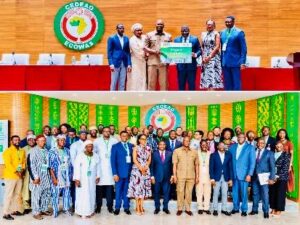
The programme, known as the Regional Rice Resilient Value Chains Development Programme (REWARD), was unveiled in Abuja on Wednesday, November 11, 2026, as part of efforts to strengthen regional food security, expand agricultural production and reduce dependence on imported rice.
Speaking at the unveiling, ECOWAS Commissioner for Economic Affairs and Agriculture, Mr Dehpue Zuo, described the initiative as a major step towards building a resilient and competitive regional rice sector.
Zuo disclosed that the programme had an overall investment portfolio of approximately $25 billion, with $1.5 billion in firm financial commitments mobilised during a regional financing conference held in Accra.
He said the funding would support farmers, agribusinesses, agricultural production and the development of resilient rice value chains across participating countries.
According to him, the Abuja event also marked the establishment of a steering committee responsible for providing strategic oversight for the programme's implementation between 2025 and 2035.
He called on governments, development partners, private investors and other stakeholders to work collectively towards achieving the region's rice self-sufficiency target.
West Africa Needs 35 Million Tonnes of Rice
Earlier, the Coordinator of the ECOWAS Rice Agenda and REWARD Project, Mrs Boladale Adebowale, described rice as a strategic staple crop whose development was essential to the region's food security.
She disclosed that West Africa currently produces enough rice to meet approximately 60 per cent of its consumption requirements, leaving the region dependent on imports to bridge the supply gap.
Adebowale said the programme was targeting complete self-sufficiency by 2035, adding that West Africa would need to produce approximately 35 million metric tonnes of rice to meet projected consumption demands.
She explained that population growth would increase pressure on food supplies, making higher agricultural productivity, expanded production capacity and improved value-chain efficiency necessary.
According to her, REWARD would focus on developing a more productive and competitive rice industry through improved processing facilities, efficient marketing systems and increased trade among West African countries.
Five Countries Begin First Implementation Phase
Adebowale identified Côte d'Ivoire, Guinea-Bissau, The Gambia, Mali and Senegal as the first group of countries participating in the programme.
She said other ECOWAS member states would be incorporated in subsequent phases, with Nigeria expected to participate in the next phase of implementation.
Nigeria's anticipated inclusion is particularly relevant given the country's large rice-consuming population and the importance of domestic rice production to its food security and agricultural economy.
The programme also includes the establishment of the ECOWAS Rice Observatory, which is expected to serve as a coordination mechanism for interventions, investments and activities across the regional rice sector.
Adebowale said the $1.5 billion mobilised during the Accra Regional Rice Roundtable reflected growing interest and financial commitments from development partners and private-sector investors.
Development Partners, Agricultural Experts Support Initiative
The unveiling brought together government representatives, development partners, agricultural experts and private-sector stakeholders to discuss the programme's implementation and regional objectives.
Participants included ECOWAS Director of Agriculture and Rural Development, Dr Madadozi Tezike, and Director-General of AfricaRice, Dr Baboucarr Manneh, who was represented at the event.
The African Development Bank was also represented through its Vice-President, Dr Abdul Kamara.
The participation of regional and international development institutions reflects the programme's broad partnership framework, which is expected to support financing, technical cooperation and agricultural development.
Farmers and Agribusinesses Expected to Benefit
Beyond reducing dependence on imported rice, REWARD is expected to create opportunities for farmers, processors, traders and other operators across the agricultural value chain.
The programme is designed to stimulate investment, strengthen production and processing capacities, improve market access and deepen trade cooperation among participating countries.
For rice farmers, improved access to financing, agricultural technologies, processing infrastructure and wider markets could help increase productivity and improve incomes.
Agribusinesses may also benefit from opportunities in rice milling, storage, transportation, packaging and regional distribution.
However, the extent of these benefits will depend on how effectively the programme is implemented and how financial resources are distributed among participating countries and beneficiaries.
Financing and Implementation Remain Critical to 2035 Target
Despite the ambitious investment portfolio, achieving complete rice self-sufficiency by 2035 will require sustained financing, effective coordination and policies that address longstanding agricultural production challenges.
Access to affordable agricultural inputs, improved seed varieties, irrigation, mechanisation, storage facilities, processing infrastructure and reliable market connections will remain important to the programme's success.
There will also be a need for transparent financial management, measurable performance targets and regular assessments to determine whether participating countries are making sufficient progress.
With Nigeria expected to join in the next phase, the programme could provide another framework for strengthening regional agricultural cooperation and improving the resilience of West Africa's food supply system.
The challenge now is to translate the $25 billion investment ambition and the commitments already mobilised into tangible improvements in rice production, farmers' livelihoods and food availability across the sub-region.
Wakirike Herald
The Voice of Wakirike People Everywhere
Written by
wk-admin
Comments
- Be the first to comment.