Bayelsa Unveils AI-Powered Robotic Tutors at Medical University
By Wakirike Herald
Diri Unveils Digital Learning Innovations
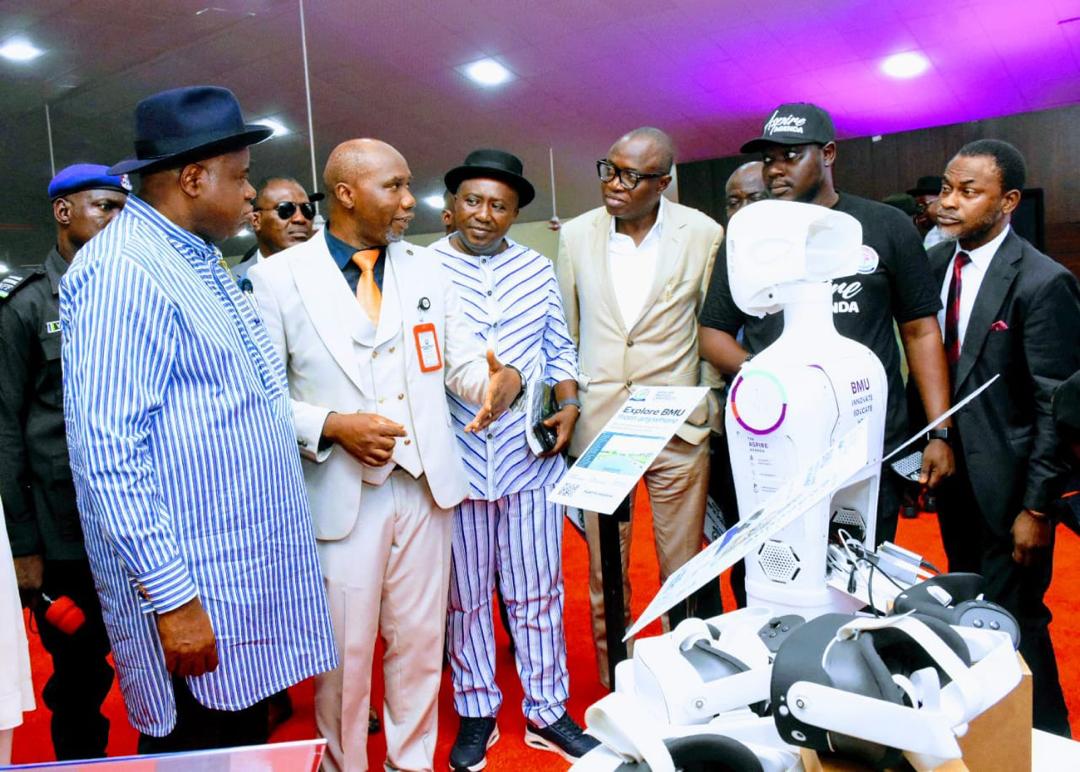
Bayelsa State Governor, Douye Diri, has unveiled artificial intelligence (AI)-powered robotic tutors and other digital learning innovations at Bayelsa Medical University (BMU), Yenagoa, as part of efforts to modernise medical education and strengthen research.
The innovations were unveiled on Monday alongside the university’s 2025–2029 Strategic Plan, which outlines its priorities for academic development, technological advancement and institutional growth.
Diri described the initiative as a step towards improving medical education through technology, stressing that digital tools should complement rather than replace human instruction.
He urged the university to use the innovations to make teaching, learning and research more interactive while preserving physical classroom engagement and the mentorship role of lecturers.
The governor also challenged the university’s management to translate its strategic plan into measurable improvements in academic standards, research, infrastructure and graduate quality.
ASPIRE Agenda Guides University Development
Diri reaffirmed his administration’s support for BMU’s ASPIRE Agenda, which focuses on academic excellence, sustainability, partnerships and engagement, innovation and technology, and research excellence.
He commended Vice-Chancellor, Prof. Dimie Ogoina, and the university management for developing a roadmap for institutional growth.
The governor urged the institution to work with the state Ministries of Education and Health to achieve its objectives.
He also said his administration was strengthening science, technical and vocational education to equip young people with practical skills for employment, entrepreneurship and self-reliance.
According to him, the science-oriented schools being established across the state are expected to provide qualified candidates for BMU and other tertiary institutions, helping to expand the pool of future doctors, nurses, pharmacists, radiologists, engineers and other professionals.
New Campus and Teaching Hospital Expand Capacity
The governor acknowledged the contributions of former Bayelsa Governor Diepreye Alamieyeseigha, who initiated the development of the former 500-bed hospital where the university is located, and his successor, Senator Seriake Dickson, who revived the project and converted it into a medical university.
Diri disclosed that the university’s campus at Sampou was nearing completion, adding that the facility would provide additional space for expansion.
He also inspected facilities at the newly established Bayelsa Medical University Teaching Hospital, expressing confidence in its capacity to provide advanced diagnostic services.
According to the governor, the hospital has facilities for X-rays and advanced imaging procedures, including computed tomography (CT) scans, which combine X-ray technology with computer processing to produce detailed images of internal body structures.
He said the availability of these services could improve access to specialised diagnosis and reduce the need for residents to travel outside Bayelsa for certain medical procedures.
Diri also toured facilities at the Bayelsa Emergency Medical Services and Ambulance System.
BMU Reports Academic and Digital Progress
Earlier, Ogoina said his vision was to develop BMU into a globally recognised institution for medical education, research and innovation, supported by technology and sustainability.
He explained that the ASPIRE Agenda was being implemented through institutional teams and initiatives designed to improve academic quality, accountability, innovation and student welfare.
The vice-chancellor disclosed that the university had secured accreditation for nine academic programmes, while its nursing science students recorded a 96 per cent pass rate in their professional examinations.
He also said BMU’s College of Medicine had attained full membership of the Consortium of Medical Schools of Africa, while the university had been selected as one of 18 medical schools in Nigeria for a high-impact intervention programme.
On digital innovation, Ogoina said the institution had established a virtual reality, artificial intelligence and mixed-reality studio, expanded digital connectivity and introduced a “Talk to the VC” application to enable students and staff to communicate directly and confidentially with the university leadership.
He added that BMU was strengthening simulation-based learning through its clinical skills laboratory and pursuing plans to develop a smart campus, improve internet connectivity and increase internally generated revenue.
Digital Health Research and Regional Challenges
Ogoina said the university was also developing a Centre of Excellence for Digital Health and Biomedical Innovation, alongside the Niger Delta Centre of Excellence for Health, Environment and Development.
The centres are intended to support research and innovation addressing health and environmental challenges in the Niger Delta.
The introduction of AI-powered teaching tools and digital simulation facilities could expand opportunities for medical students to engage with technology-assisted learning. Their long-term value, however, will depend on effective implementation, reliable internet access, staff training, equipment maintenance and the ability to translate research into improved healthcare services.
For Bayelsa, the university’s development carries implications beyond the classroom. Stronger medical training and diagnostic capacity could help build the state’s healthcare workforce and improve access to specialised services, provided the new facilities are adequately staffed, maintained and made accessible to patients.
Wakirike Herald
The Voice of Wakirike People Everywhere
Written by
wk-admin
Comments
- Be the first to comment.