Army Chief Tasks Calabar Amphibious Training School on Capacity Building for Expanding Force
By Wakirike Herald
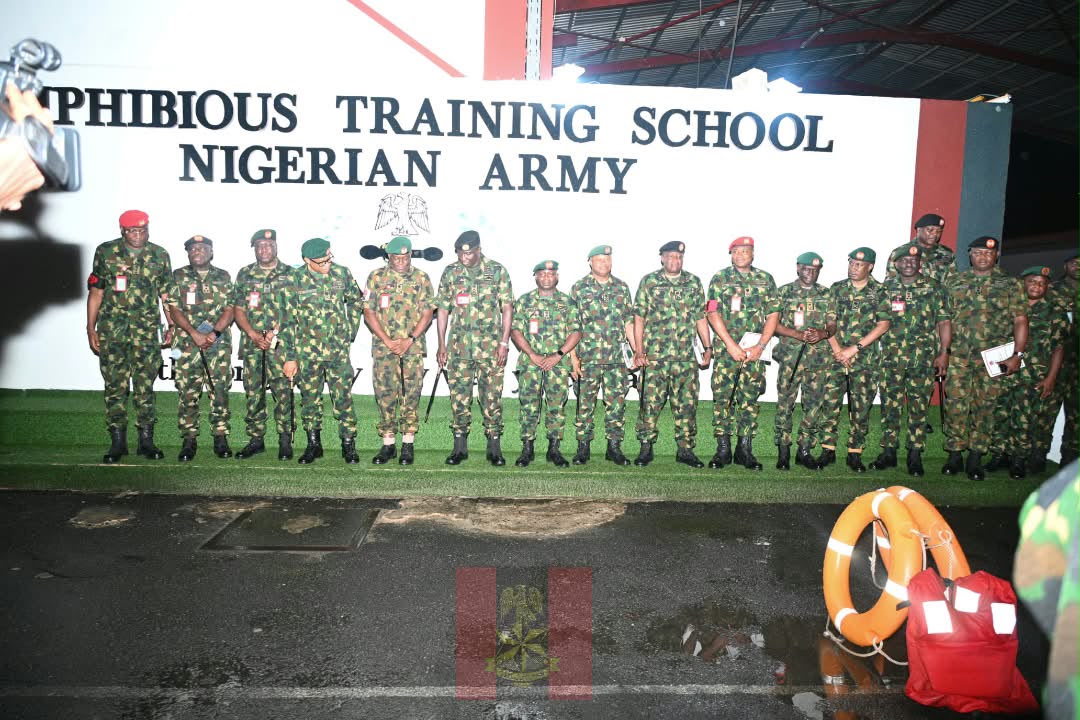
The Chief of Army Staff (COAS), Lt.-Gen. Waidi Shaibu, has called on the Amphibious Training School (ATS), Calabar, Cross River State, to strengthen its training capacity to meet the specialised manpower requirements of an expanding Nigerian Army.
Shaibu gave the directive during an operational visit to the institution, where he assessed its facilities and capacity to prepare soldiers for operations in aquatic, riverine and littoral environments.
The development was disclosed in a statement issued on Tuesday in Abuja by the Acting Director, Army Public Relations, Col. Appolonia Anele.
The Army Chief described amphibious warfare capabilities as essential to building a professional, adaptable and combat-ready force capable of responding effectively to Nigeria's evolving security challenges.
He commended the school for its contribution to producing military personnel equipped to operate across rivers, creeks, wetlands and coastal environments.
Riverine training critical to national security
According to Shaibu, amphibious proficiency improves troop mobility, operational flexibility and combat effectiveness, particularly in difficult terrains that terrorists and other criminal elements could exploit.
He noted that the increasing complexity of Nigeria's security environment had made specialised military training indispensable to protecting strategic waterways, safeguarding critical national infrastructure and disrupting criminal networks.
The COAS also highlighted the importance of amphibious capabilities in supporting joint military operations involving the Nigerian Army, other armed services and security agencies.
He stressed that effective operations in riverine and coastal environments required personnel with specialised knowledge, technical competence and the ability to adapt to challenging operational conditions.
Army expansion requires stronger training institutions
Shaibu said the Federal Government's efforts to expand Army formations, strengthen manpower and modernise operational capabilities must be matched by corresponding investments in military training institutions.
He identified the Amphibious Training School as an important institution for translating the Army's expansion and modernisation plans into practical operational capabilities.
The Army Chief urged instructors to maintain high training standards and encouraged trainees to demonstrate discipline, resilience and professionalism.
He added that training facilities, instructional equipment, teaching methods and manpower must continually evolve to meet the requirements of an expanding and technologically advancing military force.
Army Headquarters promises institutional support
The COAS assured the school that Army Headquarters would support efforts to upgrade its infrastructure, training facilities and instructional equipment.
He maintained that developing highly skilled personnel remained central to building a responsive and resilient Nigerian Army capable of fulfilling its constitutional responsibilities.
Strategic importance for Nigeria's coastal communities
The emphasis on amphibious training carries particular significance for Nigeria's coastal and riverine regions, including the Niger Delta, where extensive waterways, creeks and wetlands present distinct security and operational challenges.
Beyond military mobility, effective security operations in these environments are important to protecting maritime transportation, coastal infrastructure, economic activities and communities whose livelihoods depend on waterways.
For the Amphibious Training School, the challenge will be to translate the proposed institutional improvements into stronger training standards, modern facilities and personnel capable of responding to the country's changing security needs.
Wakirike Herald
The Voice of Wakirike People Everywhere
Written by
wk-admin
Comments
- Be the first to comment.