Abia Information Commissioner Urges Journalists to Prioritise Verification Ahead of 2027 Elections
By Wakirike Herald
Abia State Commissioner for Information, Mr Okey Kanu, has urged journalists to prioritise truth, accuracy and verification over speed and sensationalism as Nigeria prepares for the 2027 general elections.
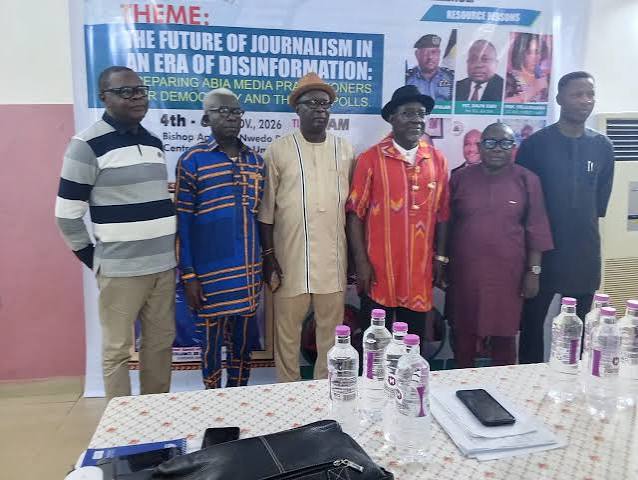
Kanu made the appeal on Wednesday during the opening of the 2026 Media Retreat and Press Week organised by the Correspondents Chapel of the Nigeria Union of Journalists (NUJ), Abia State Council, in Umuahia.
The retreat, themed 'The Future of Journalism in an Era of Disinformation: Preparing Abia Media Practitioners for Democracy and the 2027 Polls', focused on the growing threat of misinformation and the responsibilities of journalists in protecting democratic institutions.
Kanu commended the organisers for selecting a theme that addressed what he described as the increasing weaponisation of information.
He described journalism as a bridge between government and citizens, as well as a watchdog responsible for holding public institutions accountable.
However, he cautioned that press freedom should not be used to justify distortion of facts, misrepresentation of issues or the deliberate manufacture of narratives against government.
According to him, the future of journalism belongs to practitioners who verify information thoroughly rather than those who prioritise publishing first or generating attention-grabbing headlines.
AI Technology Raises New Challenges for Journalism
The commissioner warned that artificial intelligence was creating additional challenges for the media industry, particularly through the production of fake images, impersonation of public figures and fabricated audio recordings capable of misleading the public.
He urged journalists in Abia to embrace continuous professional development, digital literacy, investigative reporting, fact-checking and the responsible application of emerging technologies.
"The modern journalist must be more than a good writer or an excellent broadcaster.
"He or she must be a critical thinker, a digital investigator, a responsible storyteller and a guardian of public trust," Kanu said.
INEC Warns Against Disinformation Ahead of 2027 Polls
Also speaking, the Independent National Electoral Commission (INEC) Resident Electoral Commissioner in Abia, Prof. Sylvia Agu, described the media as an indispensable partner in the electoral process.
Agu said the outcome and credibility of the 2027 elections would depend not only on activities at polling units but also on public perception, information and trust.
She warned that media coverage of electoral activities could either strengthen or undermine public confidence in INEC.
The REC identified public distrust as a major challenge facing the commission, arguing that many of its difficulties would diminish if Nigerians had greater confidence in the electoral system.
Describing the 2027 elections as a defining moment for Nigeria, she noted that technology could serve both as an instrument for improving electoral transparency and a potential source of manipulation.
REC Explains Electoral Act and BVAS Provisions
Agu said the Electoral Act 2026 would guide the electoral process, while highlighting the role of the Bimodal Voter Accreditation System (BVAS) in addressing certain electoral irregularities during previous elections.
She explained that BVAS could help expose discrepancies where the number of votes recorded exceeded the number of accredited voters.
The REC also credited the technology with helping to protect the integrity of the 2023 elections in Abia, which produced Governor Alex Otti.
She further referred to Section 60(3) of the Electoral Act, which provides for the electronic transmission of polling-unit results from Form EC8A to INEC's Result Viewing Portal (IReV).
According to her, Section 60(6) prescribes six months' imprisonment or a fine of ₦500,000 for anyone found guilty of frustrating the transmission process.
Agu also drew attention to Sections 92 to 97, which she said criminalised the publication of false statements intended to discredit political candidates or the electoral process.
Former SSG Calls for Accountability in Journalism
Earlier, former Secretary to the Abia State Government, Chief Ralph Egbu, urged journalists to resist misinformation, disinformation and propaganda ahead of the 2027 elections.
Egbu challenged media practitioners to remain accountable, uphold professional ethics and independently investigate government activities rather than rely exclusively on official press statements and rumours.
Expressing concern about declining public confidence in journalism, he asked: "Who will watch the watchdog? The watchdog is severely wounded?"
He urged journalists to return to the principles of verification, fairness and balanced reporting to rebuild public trust.
NUJ Organisers Outline Objectives of Three-Day Retreat
The Chairman of the Correspondents Chapel, Mr Steve Oko, said the three-day retreat was organised to strengthen the professional capacity of journalists in the state.
He explained that the programme was designed to equip practitioners with the knowledge and skills required for accurate, balanced, verified and responsible coverage of the 2027 general elections.
Oko added that the retreat would prepare Abia journalists to identify and counter fake news while reporting electoral developments professionally and without bias.
Credibility Remains Central to Democratic Journalism
The discussions at the retreat highlight the growing responsibility of the Nigerian media as political activities intensify ahead of the 2027 general elections.
With artificial intelligence making fabricated content increasingly sophisticated, journalists face the challenge of distinguishing credible information from deliberately manipulated material.
Beyond reporting political campaigns and electoral activities, the media will be expected to scrutinise institutions, examine competing claims and provide citizens with reliable information to make informed democratic decisions.
Ultimately, the credibility of election reporting will depend not on how quickly information reaches the public, but on how accurately and responsibly it is presented.
Wakirike Herald
The Voice of Wakirike People Everywhere
Written by
wk-admin
Comments
- Be the first to comment.